With temperature changes, pollen, and everything else that comes with the change of seasons, taking care of our health can be quite a challenge.
But spring, with its warmth and gentle smiles, is just around the corner.
Let’s somehow get through this season together!
Today, I’d like to talk about seasonings—something I’ve found very helpful for managing my health, including during pollen season.
Real, Traditionally Made Seasonings Can Make a Difference
Through my own experience of improving my allergies, I came to realize firsthand how deeply food is connected to both the mind and body.
And among the foods we eat, I’ve come to feel that seasonings are especially important.
I also realized that seasonings do more than simply add flavor—they can play an important role in supporting the foundation of our health.
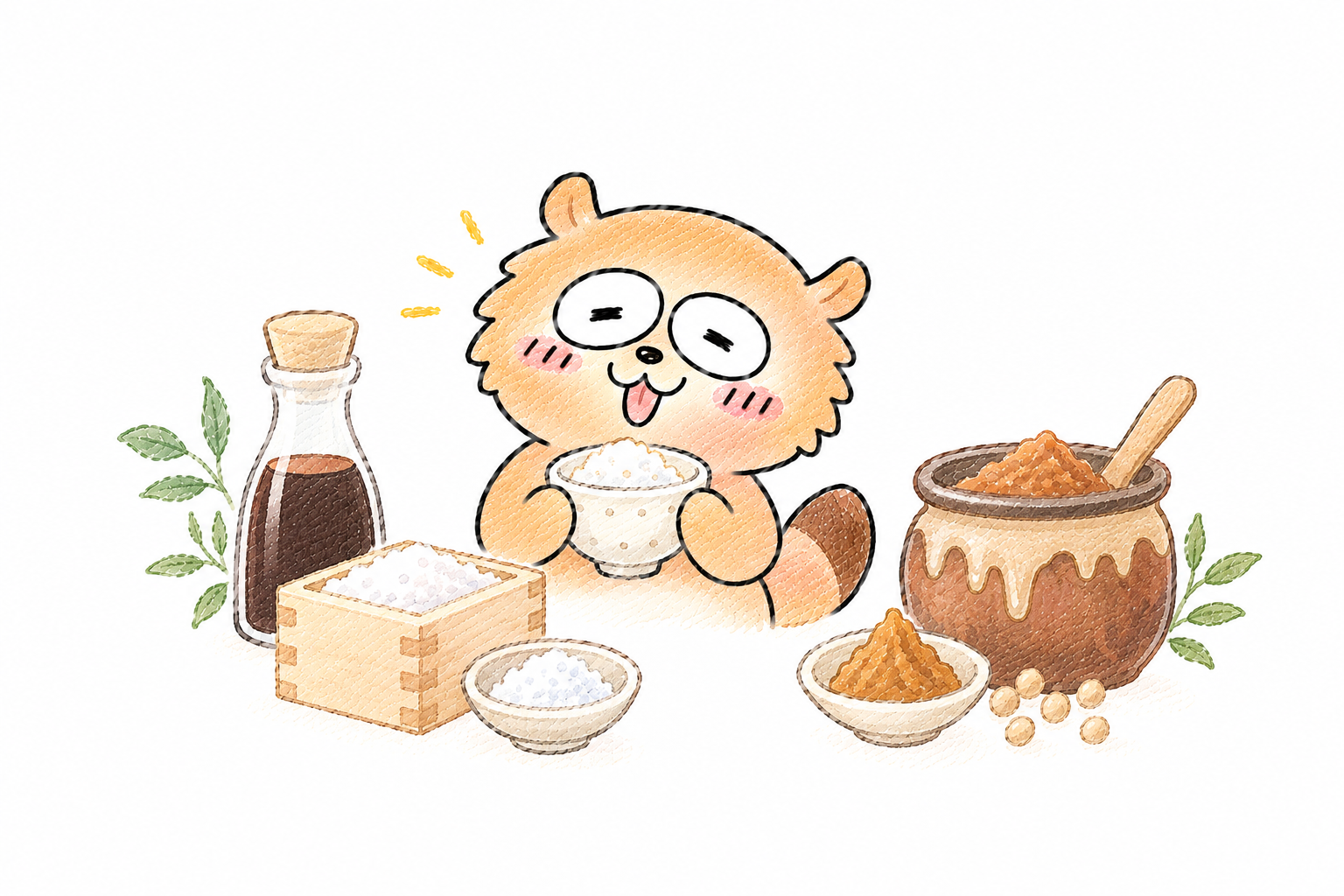
The main seasonings we use at home are salt, soy sauce, and miso.
After trying many different products, these are the ones I currently use:
- Salt: Sun-dried salt made by Japanese salt company, Uminosei.
- Soy sauce: Naturally brewed soy sauce made by Uminosei.
- Miso: Naturally brewed and six-year-aged miso made by Japanese miso company, Suyamo. (Sold by Anata to Kenko-sha)
When choosing seasonings at a supermarket or elsewhere, I personally recommend looking for naturally brewed products without additives.
For salt, I prefer products made without ion-exchange membrane processing, using traditional sun-drying and flat-pan evaporation methods.
Unrefined natural salt contains a well-balanced range of minerals from the sea, along with a natural depth of flavor.
That’s why even simply seasoning steamed vegetables or soup with salt can make them incredibly delicious.
The other day, I sprinkled some salt over steamed cabbage, and it was absolutely delicious!
Naturally brewed miso and soy sauce contain enzymes and microorganisms that have developed over a long period of fermentation.
There’s something about the deep, complex flavor created by these microorganisms that makes me feel truly at ease.
When your seasonings taste good, you naturally start making more simple meals.
Because the food tastes delicious without requiring much effort, cooking becomes so much easier.
I also started feeling better physically.
I experience every day that changing my seasonings can make a difference in how I feel.
Real Seasonings Are Rich in Minerals, Enzymes, and Microorganisms
So, why can changing seasonings make such a difference?
Traditionally made seasonings are often aged for long periods without relying on additives, making them a source of minerals, enzymes, and microorganisms.
That’s right—real soy sauce and miso can contain living microorganisms!
Once these microorganisms enter the body, they may interact with and support the gut microbiome.
The bacteria in our gut produce various substances, including certain vitamins, enzymes, and hormones that are important to the body.
Serotonin, one of the neurotransmitters involved in regulating mood, is also produced largely in the gut.
In addition, metabolites produced by gut bacteria, including short-chain fatty acids, have been found to play various roles, such as:
- Energy production
- Supporting digestion, absorption, and bowel movements
- Helping prevent obesity
- Supporting metabolism
- Suppressing inflammation
- Regulating immune function
and more.
It turns out that eating traditionally made seasonings can be more meaningful than I ever imagined.
For just a few hundred yen more, I can enjoy seasonings that taste absolutely delicious every day—and if they also help support the gut microbiome, that feels like a wonderful bonus!
Actually, there have been many times when I was desperate enough to try expensive supplements, hoping they would help.
But so far, I’ve never felt that any of them made a noticeable difference.
I wonder how much money I spent on them…! 😂
In the end, simply changing the seasonings I use every day turned out to be the best “supplement” I could have asked for.
Real seasonings are alive.
For me, the difference between something being alive and not being alive turned out to be a very big one.
Real Seasonings for Busy Modern Life
Allergies are becoming increasingly common these days.
It is sometimes said that whereas allergies affected about 1 in 1,000 people 50 years ago, they now affect 1 in 2 or 3 people.
Changes in our diet may be part of the reason, but one theory is that modern lifestyles that have become too disconnected from microorganisms may also contribute to the rise in allergies.
Our bodies are supported by countless microorganisms.
I feel that excessively eliminating microorganisms through things like disinfection and additives may also weaken our own natural resilience.
After all, we are not separate from microorganisms—we are a living community made up of many different organisms.
Of course, there are situations where hygiene measures are necessary, but perhaps it is better not to eliminate microorganisms more than necessary.
Originally, our gut bacteria were thought to become more active and diverse through contact with nature and soil, such as by spending time outdoors or working in gardens and fields.
The growing number of people living lifestyles increasingly disconnected from soil may also be related to the rise in allergies and other immune-related conditions.
In the past, it was also common for families to make their own miso and pickles at home.
People would even mix their rice bran pickle beds every day, so their homes were apparently filled with all kinds of beneficial microorganisms.
In other words, people naturally lived lifestyles that allowed them to come into contact with plenty of microorganisms.
Of course, it’s not easy to suddenly start living that way today.
I’m also trying to incorporate some of these practices little by little.
Last year, I made umeboshi (Japanese pickled plums) for the first time, and I was so happy with how delicious they turned out.
I didn’t let the plums ripen enough beforehand, though, so they were a little hard. 😂
Even if you’re not ready to make your own fermented foods, changing your seasonings is something you can start doing right away.
For busy people juggling work, housework, and everything else, starting with traditionally made seasonings may be one simple way to incorporate more of the benefits of microorganisms into everyday life.
Thank you, as always, for reading! 😊