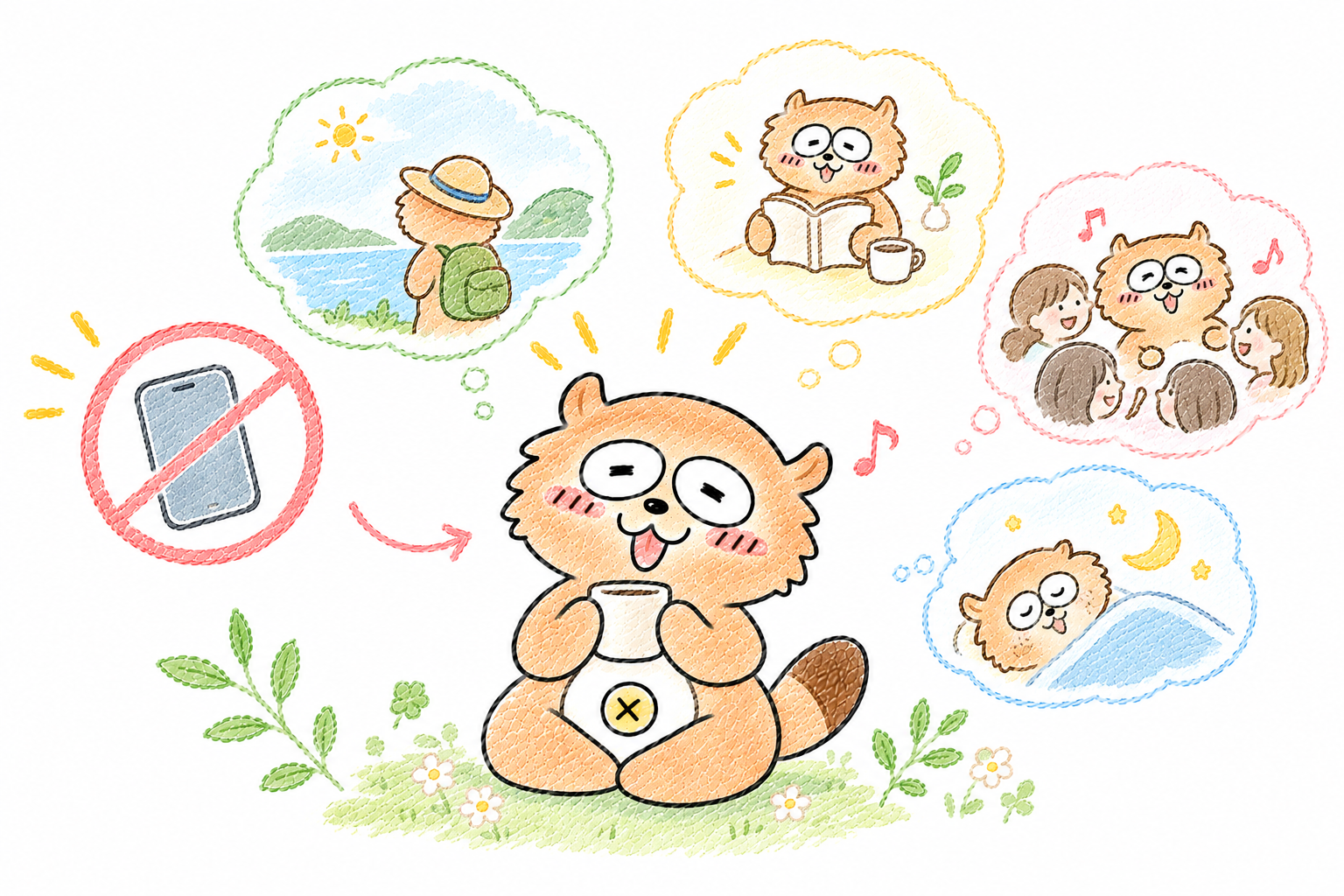
I gave up my smartphone in January 2020.
These days, so many services are designed around smartphones that people are often surprised when I tell them I don’t have one.
My friends are also connected through Japanese messenger app called LINE, and sometimes I feel bad asking them to contact me individually by email.
Even so, why do I choose to live without a smartphone?
Today, I’d like to share what led me to give up my smartphone and what changed after I did.
What Made Me Give Up My Smartphone
In 2019, I was diagnosed with multiple chemical sensitivity (MCS). During my medical visits, my doctor gave me some advice about using smartphones.
People who are sensitive to chemicals can sometimes also become sensitive to electromagnetic fields, and I was advised to avoid using my smartphone for long time.
However, as long as I had a smartphone, there were times when I would end up using it for hours.
Especially when I was tired, my self-control became weaker, and I would endlessly browse the internet or watch videos…
Sometimes I would spend a long time researching illnesses and health issues, too.
Trying to limit my smartphone use required a lot of willpower.
Then I thought, “If that’s the case, why not just get rid of it altogether?”
I looked into my options and discovered a phone model that could be used mainly for calling, without all the smartphone functions.* So I decided to switch phones.
*The model was “Simply,” released by SoftBank in Japan.
What Happened Right After I Gave Up My Smartphone
For a while after giving up my smartphone, I felt frustrated that I couldn’t search for things whenever and wherever I wanted.
I realized just how dependent I had become on this convenient little device.
When I had a smartphone, I would quickly take it out and do something whenever I had a spare moment.
Once that was gone, I felt strangely restless, as if I didn’t know what to do with myself.
I constantly felt like I wanted to look at something, get more information, or have some kind of stimulation.
That feeling continued for a while.
It was also inconvenient when I went out because I couldn’t look up train schedules or maps on the spot.
I had to research everything beforehand on my computer and make notes before leaving the house.
And if something unexpected happened, I simply had to figure it out myself.
But little by little, I got used to these inconveniences.
After all, I had originally lived perfectly well without a smartphone, so I suppose it was only natural that I could adapt.
That said, nowadays, so many services assume that everyone has a smartphone.
You may have trouble getting a taxi simply by standing and waving, and there are procedures and payment systems that can’t be used without a smartphone.
In that sense, living without one may actually be more difficult now than it was before smartphones became commonplace.
Even so, I discovered that with a little creativity, it’s possible to live without feeling all that inconvenienced.
I make phone calls and send text messages on my basic phone, and use my computer for email.
When I’m going somewhere, I do plenty of research beforehand.
If I want to use a particular service, I check in advance whether it can be used without a smartphone.
If it can’t, I look for another option.
And so on…
It turns out you can manage surprisingly well.
Enjoying Both Convenience and Inconvenience
Four full years have passed since I gave up my smartphone.
I’ve become completely accustomed to life without one, and I’ve even come to find some of the inconveniences enjoyable.
Even if I get lost or something unexpected happens, things somehow work out.
More than that, I love the simplicity of my life and the lightness I feel from stepping away from information overload.
I’ve found more ways to gather information besides searching on my smartphone: reading books and newspapers, listening to talks, and asking other people for advice.
At the same time, I’ve become less attached to the idea that things “have to be done a certain way.”
One day, I happened to see an elderly woman at a supermarket quickly holding up her smartphone to pay.
I honestly thought, “Wow, that’s pretty cool.”
Maybe I’m allowed to make my own choices and enjoy life more freely.
I want to understand both the good things about analog life and the good things about digital life, and learn how to make use of both.
Recently, my husband needed a smartphone for business trips, so we signed up for one again.
He had given up his smartphone at the same time I did, so suddenly, after all these years, a smartphone made its way back into our home.
We decided to share it and use it when traveling and for other occasions.
So we’re back to having a smartphone in our lives—but one smartphone for the whole household, rather than one for each person.
And this time, we don’t have the same dependency we once did.
Taking a step back from smartphones for a while seems to have helped us find a way of using one that feels comfortable for us.
Also, because we have one smartphone for the household rather than one per person, there are naturally times when we’re away from it.
That feels like a pretty healthy distance.
The Digital Minimalist Way of Life
Some time ago, I read Digital Minimalism by Cal Newport.
In the book, he discusses the nature of smartphone and internet addiction.
He explains that major technology companies know they make more money the longer people spend using smartphones and the internet, so they create systems designed to make us want to keep using them for longer.
For example:
- You’re reading online news and come across something particularly interesting or provocative, so you keep clicking on one intriguing headline after another.
- You connect with other people through social media and find yourself emotionally affected by every comment, “like,” and reaction.
- Convenient apps become deeply embedded in your daily life until you feel like you can’t live without them.
According to the book, these are examples of how we can get caught up in the systems created by major technology companies.
There is also something known as the “attention economy,” in which companies make money by capturing and holding people’s attention. It is an area that companies actively research.
In other words:
Our time = their profit.
If we become happier as a result, it might seem like a win-win situation.
But unfortunately, reality isn’t always that simple.
There are little pockets of free time in our lives between work and household chores.
Today, many people spend those moments looking at their smartphones or browsing the internet.
When this happens, our attention is constantly directed outward, leaving less time to turn our attention inward.
As a result, it can become harder to observe and regulate our emotions, think deeply, and make deliberate choices based on our own judgment. We may also become more emotionally unsettled.
So what can we do?
According to the author, using the empty spaces in our days for the following activities can improve our quality of life:
Moving our bodies
Connecting with other people
Spending time in nature
Humans have known through experience for a very long time that these things are essential for maintaining physical and mental well-being.
The author also suggests the following approach to using new technologies:
[How to Use New Technology]
1. Think about the benefits and drawbacks for yourself.
2. If the benefits are significant, consider whether there are other ways to accomplish the same goal.
3. If you decide to adopt the technology, maximize the benefits while minimizing the drawbacks.
In this way, we can use technology consciously and intentionally, rather than letting it dictate how we live our lives.
This is the idea behind digital minimalism.
I think this way of thinking will become increasingly important in the future—not just when it comes to smartphones and the internet, but with all kinds of technology.
As human beings, I want to maintain a healthy mind and body while also enjoying the benefits that technological progress can bring.
I hope I can continue developing a sense of balance between the two.
Thank you for reading. 😊