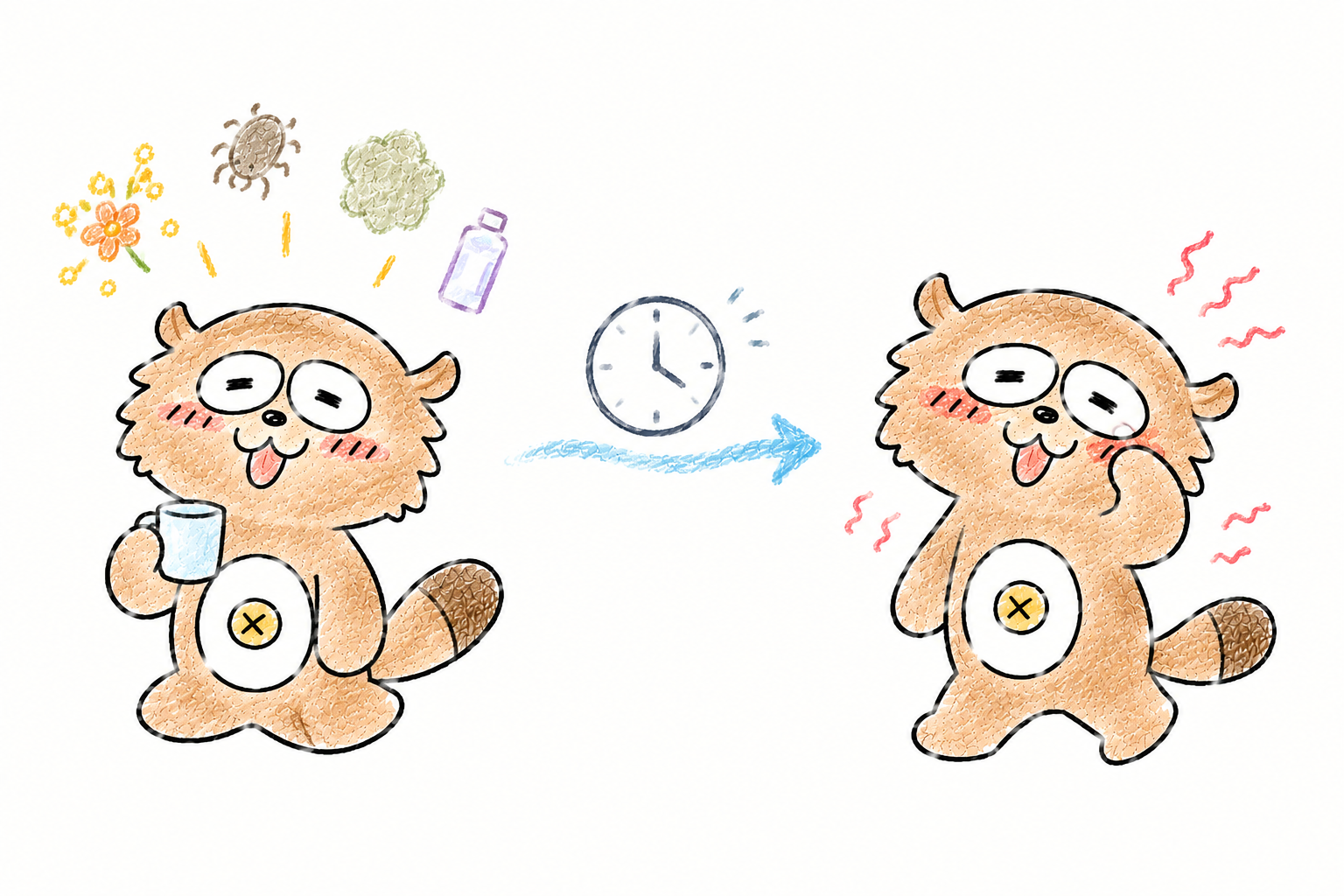
Today, I’d like to write about something that helped me when I was trying to figure out the cause of unexplained health problems:
“Symptoms peaking 48 hours later.”
You may say, “What does that mean?”
But once you know about the possibility of delayed reactions, it may help you to understand what is going on with your body.
There Are Different Types of Allergic Reactions
Allergic reactions are broadly divided into immediate reactions and delayed reactions.
With an immediate allergic reaction, symptoms such as difficulty breathing or hives can appear soon after eating a trigger food.
With a delayed reaction, symptoms may appear some time after eating the food that triggered them.
Symptoms can vary widely. In my case, I experienced things such as shortness of breath, heart palpitations, headaches, stiff shoulders, lower back pain, indigestion, fatigue, and feeling emotionally unwell.
Sometimes, I couldn’t take in what people were saying to me, and my ability to think and make decisions seemed to decline.
It felt as though my brain were covered in fog, which is why this kind of state is sometimes described as “brain fog.”
For me, symptoms would gradually begin after the trigger had entered my body, reaching their worst point around 48 hours later.
This was roughly what it looked like:
Around 24 hours later: symptoms would begin to appear.
Around 48 hours later: I would be feeling quite awful.
Around 72 hours later: I would finally start to feel a little better.
Because the symptoms appeared with such a time lag after eating a particular food, it was extremely difficult to identify the cause.
And if there was more than one possible trigger, figuring it out on my own became even more difficult.
It was quite a challenge.
How I Tried to Identify Delayed Food Reactions
If you don’t have any idea what is causing your symptoms, you may continue struggling with them for a long time.
Two approaches I tried were:
1. Keeping a food diary
2. Taking a test for delayed food reactions
I tried both.
The first approach takes a long time, and there is also a possibility of mistakenly deciding that something is the cause when it actually isn’t.
Still, because you can do it without spending much money, I think it’s worth trying.
If your symptoms are severe and you really want to investigate possible triggers sooner, the second option may be something to consider.
Testing may be available at medical facilities, and there are also tests that allow you to collect a blood sample yourself and send it to a laboratory from home.
However, these tests are generally not covered by health insurance in Japan, so they can be relatively expensive.
Once You Know Which Foods May Be Causing a Reaction
Once I identified foods that seemed to be causing reactions, I stopped eating them for a certain period and observed how I felt.
However, please be careful about continuing an elimination diet based solely on your own judgment, as removing too many foods can lead to unexpected nutritional imbalances.
In my case, testing showed moderate to strong reactions to the following foods:
milk, eggs, wheat, oats, corn, almonds, cashews, pistachios, peas, soybeans, potatoes, and mussels.
The results matched my own experiences surprisingly well.
I had already stopped eating many of these foods, but I hadn’t realized that soy might be an issue. I had been eating tofu almost every day.
When something feels wrong, I came to believe that there is often a reason behind it.
After I stopped eating tofu and drinking soy milk, I felt better.
Interestingly, I seem to tolerate other fermented soy products, such as natto, miso, and soy sauce.
From my own experience, fermented soy products seem to have less effect on me.
Of course, I think this varies from person to person, so ultimately, it’s important to pay attention to how your own body responds.
It is sometimes said that avoiding a trigger food for around six months may reduce the intensity of reactions.
However, foods such as milk, eggs, and wheat are common allergens, so even if your reaction becomes milder, it may become stronger again later.
Even after you start feeling better, it may be worth avoiding eating the same potentially problematic foods too frequently.
In general, I think it’s important not to eat excessive amounts of the same foods over and over again.
To avoid creating new problems, it may be better to avoid relying too heavily on a small number of favorite foods.
Working Toward Better Long-Term Health
Finding foods that triggered my symptoms and avoiding them was necessary for me to get out of the worst condition.
For me, it was more like treating the symptoms rather than addressing the underlying issue.
The next thing I felt was important was working toward a body that was less prone to these kinds of reactions.
For me, that meant focusing on supporting my gut health.
I came to think that my digestive system might have been weakened and that this could have contributed to my reactions.
There is a theory that when the intestinal lining is compromised, incompletely digested food particles can pass through the intestinal barrier and contribute to immune reactions.
I also found that when my digestion was not working well, foods that were difficult for me to digest seemed to contribute to feeling unwell.
So I came to believe that taking care of my gut could help reduce my symptoms over time.
Ways I Try to Support My Gut
1. Don’t eat or drink too much.
2. Avoid foods and drinks that don’t agree with me.
3. Keep my body warm.
4. Get moderate physical activity.
5. Try not to accumulate too much stress.
I still feel that I have some work to do, especially with numbers 1 and 5.
But even simply being conscious of these things has definitely made a difference in how I feel.
Yes, this is practice, too!
There’s no need to aim for perfection from the very beginning.
We can simply get a little better, step by step.
And hopefully, as we do, our health will gradually start moving in a better direction.
When Something Just Doesn’t Feel Right
Your body feels awful even though you can’t think of any obvious cause.
Or you just can’t seem to shake that feeling of being emotionally down.
When that happens, something you ate or drank 48 hours earlier might be worth considering as one possible clue.
Of course, it’s not good to become overly concerned about every little thing.
But if you’re experiencing persistent or troubling symptoms, it may be worth looking into possible patterns with the help of a healthcare professional.
Sometimes, the possible trigger may even be something you love and consume frequently.
When you’re feeling unwell, simply understanding that your symptoms might be related to a delayed reaction can sometimes make things feel a little easier emotionally.
Even when the symptoms are the same, there can be a big difference between thinking,
“What is happening to me? When will I ever get better?”
and thinking,
“Maybe this is a delayed reaction. Perhaps I’ll start feeling better within a few days.”
Having an explanation can make the experience feel much less frightening.
Summary
I think the basics are still the most important things:
Taking care of what we eat, what we wear, and the environment we live in, getting moderate exercise, and spending some time in the sunlight.
By moving away from things that feel overly artificial and getting closer to a more natural way of living, I hope both my gut and my body will feel better.
I want to build a strong foundation for my health and gradually create a body and mind that aren’t easily thrown off by every little thing.
Thank you so much for reading today! 😊
Note: Everything written in this article is based on my personal experience and should not be taken as medical advice or assumed to apply to everyone. If you have persistent, severe, or concerning symptoms, please consult a qualified healthcare professional.