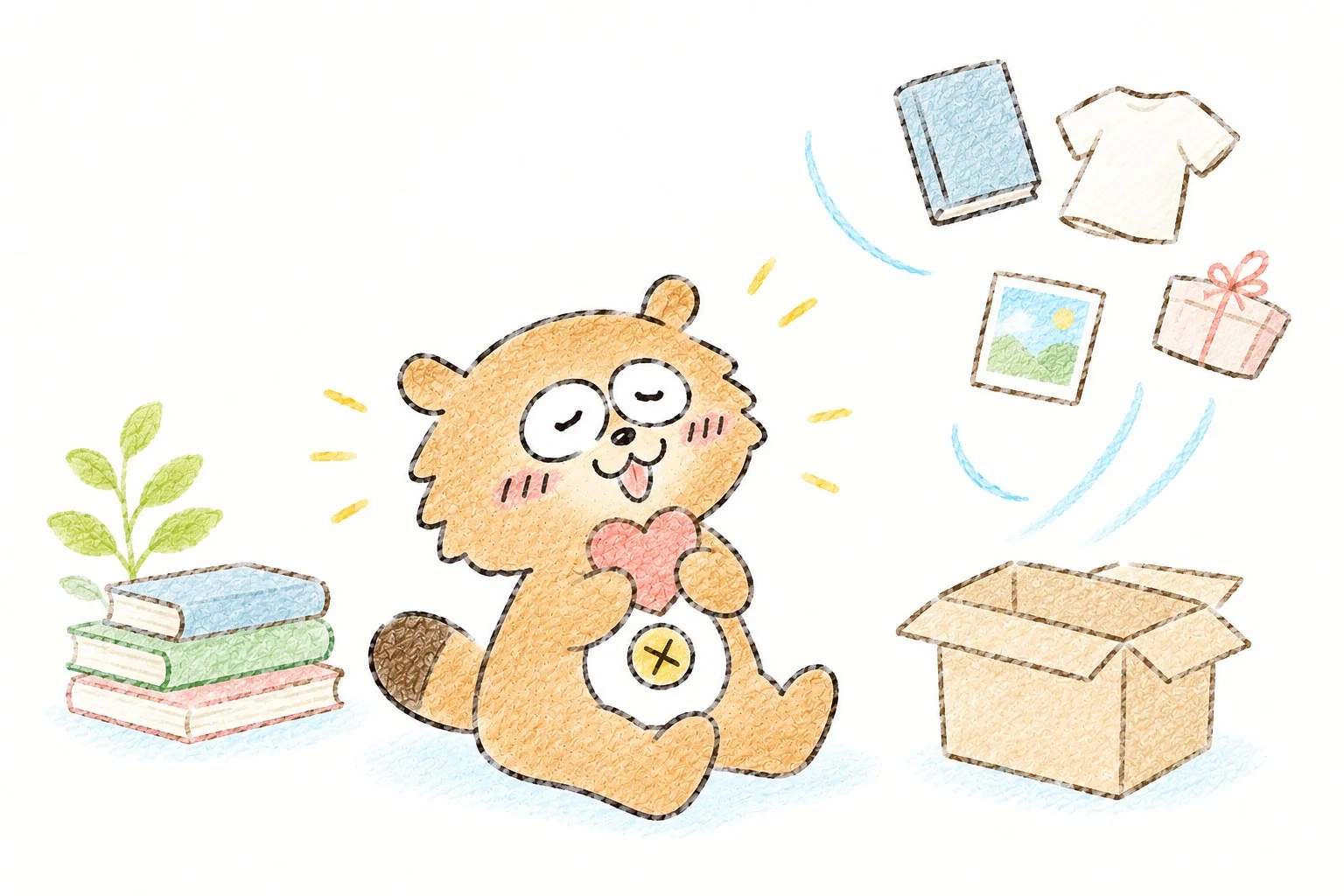
Lately, I’ve been hearing more and more people say, “I want to have less stuff!”
Perhaps we are living in a time when the focus is shifting from material wealth to a richer inner life.
Recently, I had a chance to talk with someone who was interested in my minimalist lifestyle. When I asked what kinds of things she wanted to let go of, she mentioned books, clothes, and sentimental items.
Thinking back, these were exactly the things that had been the hardest for me to let go of in the past…
- Several cardboard boxes packed full of textbooks and notebooks
- Clothes I kept even though I’m not particularly interested in fashion and hardly ever wore them
- Sentimental items that I rarely looked at but still couldn’t bring myself to let go of
Looking back on those days, I’d like to share how I gradually let go of these things, one by one.
There’s also something I came to realize along the way:
When you let go, something more valuable than what you gave up may come into your life.
“Really?”
You might be wondering if that’s actually true.
I didn’t feel that way from the beginning, either.
But after 15 years of practicing letting go, when I look back, I feel that somehow, that’s exactly what happened.
It’s pretty amazing.
So, let’s take a look at what happened!
I hope you’ll come along for the journey. 😊
********
Letting Go of Books
I studied biology at university, and even after graduating and starting work, I carefully kept the textbooks and notebooks I’d used as a student.
There were several cardboard boxes full of them, which made moving house quite a challenge.
Naturally, I remember thinking, “Wow, books are heavy!” 😂
A little while after I started working, I developed bronchitis and began reducing the number of things I owned to help keep dust under control.
I think this was around 2012 or 2013.
I started by getting rid of decorative items and knickknacks that seemed particularly likely to collect dust, gradually prioritizing things that weren’t essential to everyday life.
Books were among them.
Textbooks and notebooks that I never looked at anymore.
I thought, “If I keep them, maybe someday I’ll feel nostalgic and want to look through them again.”
But at that point in my life, as I was dealing with health problems and trying to figure out how to continue working, what I needed to prioritize was the present moment.
Those books and notebooks contained a version of myself who had once dreamed of becoming a researcher and had worked so hard studying and doing research.
At the time, I still had a small dream of eventually returning to university and becoming a researcher.
But when I let go of those textbooks and notebooks, I felt that I was also letting go of some of my attachment to the version of myself who had worked so hard in the past and the version of myself who was living in the possibilities of the future.
Little by little, I felt myself becoming someone who was seriously living in the present.
That helped me focus on what was right in front of me and get through difficult times.
And the knowledge and experience I had gained through all those years of studying and research hadn’t disappeared at all.
I realized that I was still making use of them in all sorts of ways:
Understanding things objectively.
Thinking logically.
Looking at things from a biological perspective.
Experimenting and figuring things out using a research-based approach…
I had been doing all of this almost unconsciously.
I am deeply grateful to my parents for giving me the opportunity to receive an education and the lifelong gift of learning.
By the way, before letting go of particularly meaningful textbooks and notebooks, I took photos of them, page by page.
As I went through that process, I felt like I was gradually loosening my attachment to them.
I never actually looked at those photos again, though. 😂
These days, I’ve become much better at letting go without holding on so tightly.
Looking back, I realize that it was all the practice I had accumulated over the years that helped me get there.
When we let go of physical possessions, we can sometimes let go of the attachments we carry inside, too.
With practice, both our minds and bodies can gradually feel lighter.
This experience really made me feel that for myself.
☞ When I let go of my old textbooks and notebooks, I also let go of my attachment to the person I had been and the possibilities I imagined for my future—and that helped me focus on the present and overcome difficult times.
********
Another Important Experience with Books
There’s one more memorable experience involving books that I’d like to share.
Around 2020, I began studying natural therapies because I wanted to improve my health from the ground up.
As a result, my collection of books about food and health kept growing.
I even traveled with my husband to a remote mountain area in Shizuoka, Japan to hear directly from one of the authors of those books.
I went to lectures to hear the stories of people who had overcome difficult illnesses, attended workshops to learn various self-care techniques, took correspondence courses, and studied with others at healthy cooking classes…
Through the connections those books brought into my life, I gained so many valuable lessons and experiences.
A few years later, I somehow began to feel that it was time to let go of my health-related books.
So I sold all of them at Book Off, a secondhand bookstore chain in Japan.
What I realized after letting them go was that even though I couldn’t remember every word in those books, everything truly important had stayed with me.
What I had learned from natural therapies—how to take care of what I eat, what I wear, and the environment I live in, as well as how I approach life—had become woven into every part of my life.
And then something surprising happened once my bookshelf was empty.
It was as if a new antenna had gone up inside me, and suddenly, a flood of new information started coming my way!
For me, that information was about starting my own business.
And a few years later, I actually did start one…
It’s still amazing to think about.
Looking back, I think that the moment I felt ready to let go of my health-related books was actually the moment when what I’d learned from them had become a part of who I was.
Once I let them go, information about the next step I needed to take began to come into my life.
Maybe when you feel, “It’s time to let this go,” it can be a sign that you’re ready to move on to the next stage.
Could this be what people mean when they say, “When you let go, something more comes in”?
It’s really fascinating. ✨
☞ When I let go of my health-related books, information about starting a business came into my life—and eventually, I actually started one!
********
Letting Go of Clothes
About twice a year, I suddenly get into the mood and think, “Okay! Time to make an effort with fashion!”
But before I know it, I’ve completely forgotten about it…
Just two or three months ago, I got into one of those fashion moods again, bought a magazine, and now I’ve already calmed down. 😊
Apparently, I’m just not that interested in fashion after all. 😂
Even so, little by little, I’ve become more aware of what kinds of clothes I actually like.
These days, I often wear organic cotton tops and wide-leg pants.
I like cotton fabrics, natural colors such as white and brown, and simple clothes that are comfortable, easy to wear, and make me feel at ease.
These days, I make far fewer clothing mistakes, but I used to make quite a few.
Most of my mistakes came from buying clothes based on how other people might see me.
I’d prioritize how something looked over whether I actually liked it, or I’d follow trends…
Those clothes usually turned out to be uncomfortable or just didn’t feel like “me,” so I ended up hardly wearing them. 😂
Once I finally recognized this pattern, I started choosing clothes based on what I liked rather than how they might look to other people.
Since then, I’ve made far fewer mistakes!
Letting go of clothes that are still wearable can be difficult because you naturally think, “What a waste!”
Getting rid of clothes that are completely worn out shouldn’t be quite as difficult.
So I think the key is to reduce the number of clothes you bought but hardly ever wear.
And to do that, I think it’s helpful to rethink your basic criteria for choosing clothes in the first place.
For me, changing my approach from “How will other people see me?” to “What do I like?” made almost all of my clothing mistakes disappear.
I wear everything I buy on heavy rotation, so I only let something go when it has reached the end of its life.
When I pick up a piece of clothing and feel, “Ah, it’s out of energy,” I say, “Thank you,” and let it go.
Another benefit of choosing clothes based on my own preferences is that I don’t worry as much about how other people see me.
That means I don’t have to think much about creating lots of different outfits.
Just like the famous Apple founder who was known for wearing essentially the same outfit every day, I can confidently wear the same clothes day after day.
People who love fashion might find that a little boring, though. 😅
Here are the actual numbers of clothes I own:
Spring/Summer:
2 cotton tops + 2 pairs of wide-leg pants = 4 pieces
Fall/Winter:
2 cotton high-neck tops + 2 pairs of wide-leg pants (the same ones I wear in spring and summer, with cotton leggings underneath for warmth) + 1 wool cardigan + 1 down coat = 6 pieces
In addition, I have:
1 blouse + 1 pair of pants for special occasions = 2 pieces
That’s about 10 pieces of clothing in total for the whole year.
Since I love every single piece, I feel good wearing my clothes every day. ♪
And because I don’t have many clothes, I can take good care of all of them, which feels great. ✨
I recently came across an impressive Japanese minimalist online, Nozomi, who apparently lives with just three pieces of clothing a year!
One dress and two outer layers.
I don’t think I could go quite that far, but for some reason, just hearing about it makes me a little excited. Maybe that’s just the minimalist in me! 😂
Whenever I get a glimpse into a minimalist lifestyle, it often makes me question the assumptions I’ve taken for granted.
“Can you really get by with so few clothes?!”
“Wait, you can actually live without that?!”
“They have so little, and yet they look like they’re having such a good time…”
And so on.
Even if you don’t want to become a minimalist, taking a peek into this kind of lifestyle might give you some motivation to declutter your own space. 😊
☞ When I let go of clothes, I also let go of worrying about how other people see me—and now I feel good every day in the clothes I truly love.
********
Letting Go of Sentimental Items
Sentimental items are wonderful because simply picking them up can bring back happy memories, feelings of love, and precious moments from the past.
Because they carry emotional connections and a sense of connection with other people, rather than being mere physical objects, they can be very difficult to let go of.
But if you have too many of them, or you feel it’s time to organize your belongings, it might be worth carefully selecting a few to keep.
Why?
Because by choosing your favorites, you may actually find yourself looking at them more often than before.
For nearly 20 years, I carefully kept the gifts my husband had given me.
I stored them in boxes in the closet, but I hardly ever looked at them.
So I narrowed them down to my absolute favorites and started keeping them somewhere I could actually see them.
And suddenly, I found myself looking at them almost every day and feeling happy!
Instead of carefully storing everything away, selecting the things that mean the most to me and putting them somewhere visible made them feel much more present in my life.
I can almost hear someone saying, “But letting go of sentimental things is so hard!”
When something is difficult to let go of, one option is to take a photo of it.
Taking a photo gives you a little buffer before letting go, and knowing that you still have a digital record can make the process easier.
That’s exactly what I did with my old textbooks and notebooks.
Once I had taken photos of them page by page, I was able to let them go.
And as I wrote in the section about books, everything important had remained inside me.
The same is true of sentimental items.
The important feelings, memories, and bonds with the people we love are all still there, within us.
I don’t believe that letting go of an object means losing those things.
It’s interesting how simply realizing what we already have can make it easier to let go naturally.
Perhaps “when you let go, something more comes in” doesn’t necessarily mean that you should let go of something in order to gain something else.
Maybe it can also be understood as this:
Once we recognize what is already there, we stop clinging so tightly—and naturally begin to see what truly matters.
I do think it takes a little practice to get to that point, though.
A good place to start is by practicing letting go little by little, beginning with things that are relatively easy for you to release.
There’s one more question I’d like to consider:
What is important to you right now?
For me, the first things that came to mind were the time I spend with the family and friends I love.
The space where my family and I can stay physically and mentally healthy and recharge for the days ahead.
And the energy I can devote to the things I genuinely want to do.
Making sure I have enough of these things—and keeping them in good condition—is very important to me.
That’s why I try to simplify the things and tasks around me as much as possible, while also letting go of the emotional burdens I carry.
As for sentimental items, I select the ones that I want to live with in the present, and let go of the rest with gratitude.
In this way, I create more time, space, and energy to spend on the people I love and the things I truly want to do.
In other words, for me, letting go of possessions is part of creating the way of life I want to live.
Physical possessions are visible, so it’s easy to see whether they are increasing or decreasing.
But time, space, and energy are invisible, which makes them easy to overlook—even though they are incredibly valuable.
Owning possessions actually means consuming these invisible resources, too.
The time it takes to organize, maintain, and look for things.
The space needed to store them.
And the physical, financial, and emotional energy required to manage them.
So when we have fewer possessions, we gain more time, space, and energy.
And we can use those resources for the things that truly matter to us.
If we live to be 100 years old, that’s:
24 hours × 365 days × 100 years = 876,000 hours.
In other words, a lifetime is 876,000 hours of time.
How will we use this limited amount of time—our lives?
We live in a society where material goods are abundant and it’s easy to own things.
When we have an appropriate amount, our possessions can be powerful tools that support us.
But when we have too much, they can potentially become a burden instead.
I think it’s worth taking some time to look honestly at our possessions and consider whether we have the right balance.
When we find a balance that works for us, the stress and resistance we feel toward tidying up may begin to disappear.
And perhaps it can lead us even further—to thinking about what we truly want to value in life and even the bigger question:
“What am I living for?” 😊
☞ When I let go of sentimental items, I realized that everything truly important was already “there”—within me.
********
What Letting Go Has Taught Me
This time, I wanted to share my personal experiences of letting go of books, clothes, and sentimental items.
Putting all of this into words for the first time made me realize once again just how deep the practice of letting go really is.
By facing my possessions, I was also gradually learning to face my own heart—and the way I wanted to live.
I hope that through reflecting on your own relationship with your possessions, you might feel a little lighter, both physically and mentally, and find more enjoyment in your everyday life. 😊
Thank you so much for reading all the way to the end!
If you have any questions or comments, please feel free to use the contact form below. 🍀
Your warm—and sometimes very enthusiastic!—messages always encourage me. Thank you so much! ✨
🍀 Online consultations and courses are available. 🍀
For more details → One-on-One Session Online Course