
After becoming ill, I began studying natural healing and food-based approaches to health.
Along the way, one particular idea kept coming back to me:
See food not as “matter,” but as “life.”
I understood intellectually that this was important, but somehow, the idea never really reached my heart.
I realized that I had become so deeply immersed in the material world that I had lost some of my ability to truly feel the life behind the food I eat.
I started wondering if there was something I could do to reconnect with that feeling.
Then, around that time, I heard that a friend’s husband had processed a chicken himself.
When I told them I was interested, they kindly arranged an opportunity for me, and recently I was able to participate in a chicken-processing workshop.
Today, I’d like to share what I experienced.
Processing the Chicken
Each participant was given one live chicken to humanely kill and process.
The live chicken was warm.
I held its body firmly, twisted its neck three times, and then used a knife to cut it.
My hands were shaking with nerves.
But I steeled myself and did it, trying my best to minimize its suffering.
I was surprised to see that even after the head and body were separated, the body continued to move around for a while.
After that, we dipped the chicken in boiling water for about three seconds to make the feathers easier to remove.
A distinctive smell came from the chicken.
Removing the feathers was much harder and more time-consuming than I had expected.
I learned that commercially processed chicken sold in supermarkets is apparently treated with chemicals after slaughter to remove the feathers.
I had absolutely no idea.
Once the feathers were gone, it looked like the familiar chicken meat we see in stores.
And this was the moment when, rather than seeing it as a chicken, I began to think of it simply as “meat.”
We then processed the chicken into thighs, breasts, tenderloins, neck meat, wings, drumsticks, and so on.
It was my first time learning that the tenderloin is located underneath the breast and is part of the muscles used to move the wings.
For hygiene reasons, we weren’t allowed to take the organs home, but we were able to examine them.
Of course, there was only one heart.
It made me realize that a single skewer of grilled chicken heart contains the hearts of several chickens…
Cooking the Chicken
The next day, I cooked the meat I had brought home.
I wanted to really taste the chicken itself, so I decided to keep it simple and boil it in salted water.
Here is the boiled chicken:
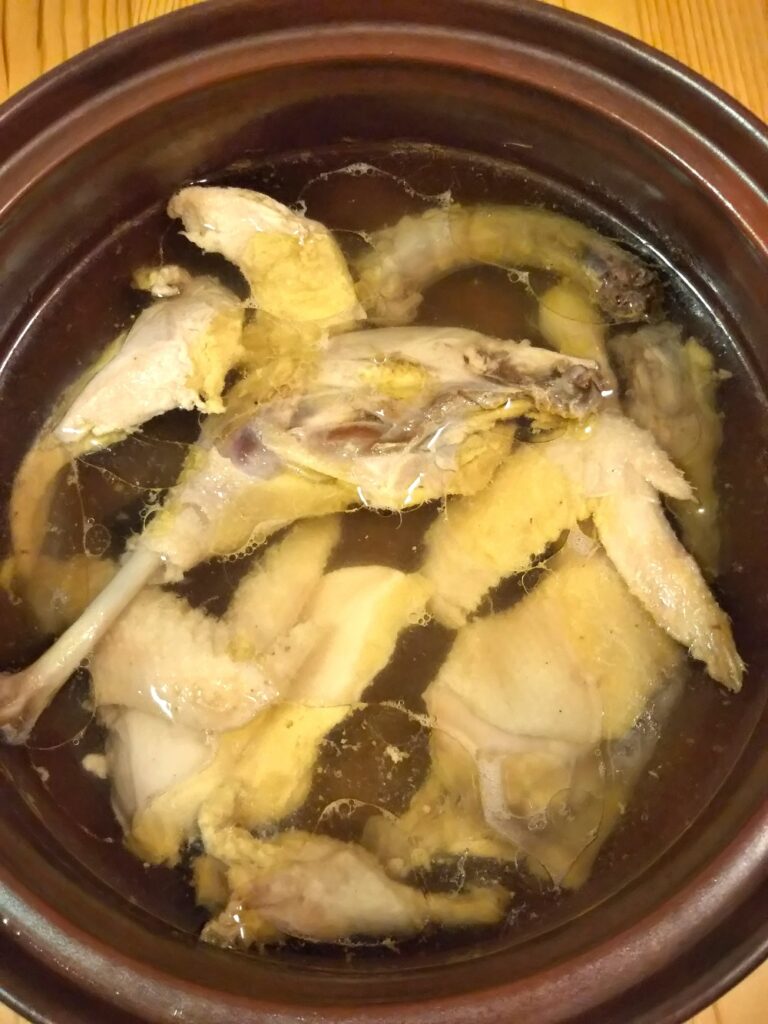
The chickens we processed this time were spent laying hens, chickens raised primarily for egg production.
Laying hens typically produce about one egg a day during the period from around five months to one year of age.
But after about a year, their egg production begins to decline, making them less economically viable, so they are often sent for processing into products such as meatballs.
The chickens we processed this time were laying hens that had passed that stage.
The reason they are used for processed meat is simple: their meat is tough.
For meat production, young chickens known as broilers are commonly used.
Broilers are a breed developed for rapid growth and good meat yield, and apparently they can be shipped for slaughter after just 45 days.
Their bodies are already quite large, but they are still apparently making little “peep peep” sounds…
Most of the chicken sold in supermarkets comes from these young birds, which is why the meat is so tender.
Eating the Chicken
This was my first time eating meat from a chicken I had personally killed and processed.
I was nervous as I took my first bite of the tenderloin.
“Wow…this is delicious!”
Next, I tried the breast meat.
“It has just the right amount of chewiness, and the flavor is so rich!”
Apparently, chickens that are raised for a longer period tend to have firmer meat than young chickens, but the flavor becomes richer and more pronounced.
The thigh, wings, and drumsticks were also delicious and beautifully rich with fat.
As I happily ate the meat straight from the bones, I found myself feeling grateful to the chicken.
My husband, who ate it with me, also said it was the most delicious chicken he had ever eaten.
In Conclusion
In order to support mass production and mass consumption, food production has become highly optimized for efficiency.
When it comes to chickens, they are divided into two main categories: chickens raised for meat and chickens raised for eggs.
Meat chickens are bred for rapid growth and good meat production, raised for a short period, and shipped out in large numbers.
In the egg industry, male chicks are generally killed shortly after hatching, while female chickens are sent for meat processing once they are no longer productive enough as laying hens.
I had continued eating meat and eggs for years without knowing any of this.
I am deeply grateful for the fact that I live in a place where I don’t have to worry about going hungry.
At the same time, I honestly feel uncomfortable with some of what goes on behind the scenes—things that are difficult to describe as natural.
I don’t know yet what I can or should do about it.
But I think I’d like to start by simply learning about what is actually happening.
This experience gave me a valuable opportunity to think more deeply about these things.
From now on, I want to continue thinking about what it means to eat—and what it means to receive another life as food.
Thank you, as always, for reading. 😊